
Why Is Your Heating Bill So High? 7 Real Cost Drivers
You turned the thermostat up two degrees, and the next statement jumped far more than two degrees' worth. Or nothing about your habits changed at all, yet the furnace runs constantly, cycling on again almost as soon as it shuts off. A high winter heating bill rarely results from a single dramatic failure. It comes from a handful of specific, physical reasons your system has to work harder than it should to hold the same temperature, and once you know what those look like, you can tell which one is driving yours.
Your Furnace Is Working Against a Bigger Temperature Gap Than You Think
Every heating system is built around a simple job: replace the heat that leaves your house as fast as it leaves. The colder it gets outside, the bigger that gap becomes, and the harder the equipment has to run to close it. A furnace keeping a home at 70 degrees when it's 45 outside does noticeably less work than the same furnace keeping it at 70 when it's 15 outside, even though the thermostat setting never moved.
This is why a single cold snap can spike a bill without any change in behavior. The equipment isn't failing. It's simply running longer, more frequent cycles because the gap between inside and outside grew. If your bill tracks closely with how cold a given week actually got, that's the temperature gap doing exactly what physics predicts, not a sign anything is broken.
A healthy system and a struggling one both get more expensive to run in a cold stretch. The difference is how much more expensive. A well-sealed, properly sized system sees a proportional bump. A system fighting other losses sees a bump that's disproportionate to how much colder it actually got, and that gap between expected and actual cost points toward one of the causes below.
Duct Leaks Send Heated Air Somewhere Other Than Your Rooms
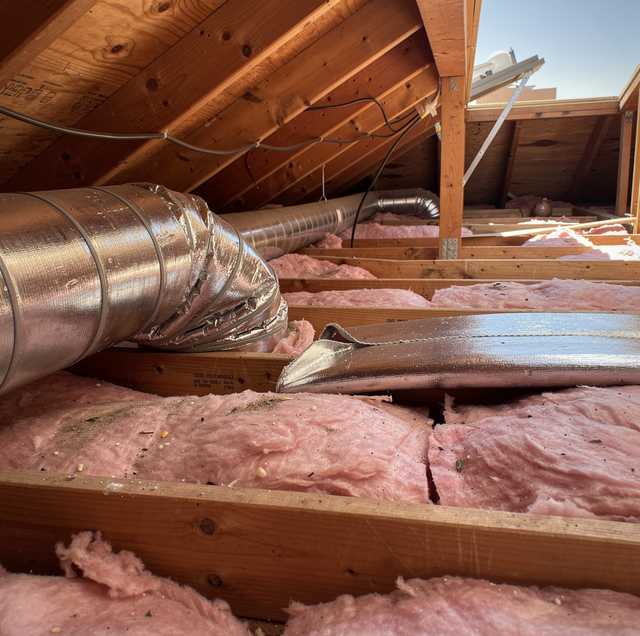
Ductwork is rarely a single continuous sealed pipe. It's built from sections joined at seams, elbows, and connections, and every one of those joints is a place air can escape before it ever reaches a vent. In an attic, crawl space, or garage, those leaks dump conditioned air into unconditioned space, which means your furnace paid to heat air that never once warmed your living room.
A duct system with significant leakage can lose a large share of the air moving through it before it ever reaches a register. Your furnace doesn't know any of that air went missing. It just keeps running because the thermostat still reads cooler than the setpoint, so it burns fuel to replace heat that already escaped into a space nobody lives in.
You can get a rough read on this yourself. Walk your attic or crawl space, if you can do so safely, and feel along visible duct joints for a faint warm draft while the system runs. Look at flex duct for crushed sections, disconnected boots, or insulation slipped away from a seam. None of that confirms exact leakage, but warm air where there shouldn't be any points straight at ductwork heating a space that was never supposed to be part of the job.
Insulation Gaps Let Heat Leave Almost as Fast as the Furnace Makes It
Insulation doesn't generate warmth. It slows how fast warmth escapes, a different job entirely, and one that matters just as much as the furnace itself. A home with thin or missing attic insulation loses heat upward continuously, day and night, whether the furnace is running or not. The equipment then replaces that lost heat on a loop that never really ends.
Attic insulation is the biggest single factor here because heat rises, and an attic floor is often the largest uninterrupted surface between your living space and the outside. Older insulation settles and compresses over the years, losing a meaningful share of its original thickness and, with it, its resistance to heat flow. A gap that was adequate when the home was built can be well below current standards decades later, without anyone having touched it.
Walls and windows matter too, on a smaller scale per square foot. Older single-pane windows and thin wall insulation both create surfaces that feel cool to the touch on a cold day, a direct sign heat is passing through rather than staying inside. If your attic access hatch feels cold to the touch, or insulation looks thin and patchy rather than even and full, that's heat loss your furnace is compensating for around the clock.
An Aging or Oversized Furnace Burns More Fuel Per Degree of Heat
Furnaces lose efficiency as they age. Heat exchangers pick up scale and residue, blower components wear, and combustion that used to be clean and complete drifts slightly off from how it ran when new. That rarely shows up as an obvious symptom. It shows up as the same furnace needing a longer runtime to deliver the heat it used to deliver in less time.
Sizing works against you in the opposite direction. A furnace too large for the space it heats doesn't run more efficiently just because it has more capacity. It short-cycles instead: firing up, quickly satisfying the thermostat, and shutting off before it settles into a steady run. Each start consumes extra fuel to reach full output, and a furnace that starts and stops constantly racks up far more inefficient moments than one running a longer, steadier cycle.
A furnace nearing the end of its service life often combines both problems: age-related efficiency loss and short-cycling from an oversized install. A technician can measure combustion efficiency and runtime directly rather than guessing, and that reading tells you whether the equipment, not the house around it, is the primary cost driver.
Thermostat Habits Change How Many Hours the System Actually Runs
The thermostat doesn't heat anything. It decides how many hours per day the equipment runs, and that decision has more influence over the bill than almost anything else in the house. Holding a single, steady setpoint around the clock keeps the system cycling gently to maintain that one number. Letting the temperature swing several degrees between an unoccupied setback and a comfortable setpoint asks the furnace for a longer recovery run, but that recovery is still shorter overall than heating an empty house to full comfort all day for no one to enjoy.
Where people run into trouble is the size of the setback. A couple of degrees for a few hours barely registers. A deep setback of ten degrees or more, especially in a home with poor insulation, can force such a hard recovery period that it erases most of the savings the setback was supposed to create. The furnace ends up running flat out for hours just to climb back to comfortable, right as everyone gets home wanting heat immediately.
A thermostat schedule matched to your actual routine, modest setbacks during empty hours, and a steady setpoint the rest of the time tends to land in the efficient middle ground. If your schedule swings wide and your bill runs high, that combination is worth a second look before you assume the equipment itself is at fault.
A Dirty Filter Forces the Blower to Work Harder for the Same Heat
A furnace filter's job is to keep debris out of the blower and heat exchanger, but every filter also restricts airflow, more so as it fills with lint, hair, and dust. A clogged filter restricts airflow enough that the blower has to work harder to push the same volume of air across the heat exchanger, and a harder-working blower draws more electricity and can drive up runtime as the system struggles to move enough warm air to satisfy the thermostat.
Past a certain point, restricted airflow becomes a safety issue rather than just a cost one. A furnace starved of air across its heat exchanger will overheat, tripping a safety switch that shuts the burners down while the blower keeps running, delivering room-temperature air that feels like a failure. Long before it gets that bad, a dirty filter is quietly forcing your equipment to spend more energy per degree of heat delivered than a clean one would.
Check the filter by holding it up to a light source. If you can't see light passing through clearly, it's restricting airflow enough to matter, and it's time for a fresh one, sized and rated correctly for your system.
Air Leaks Around the House Let Warm Air Escape and Cold Air In
Insulation slows heat moving through solid surfaces. Air sealing stops air itself from moving through gaps, a separate job that also affects your bill. Gaps around window and door frames, where pipes and wiring pass through exterior walls, and along the band where a foundation meets the structure above all let warm indoor air slip out and cold air slip in, continuously, regardless of how good your insulation is elsewhere.
This kind of air movement often shows up as a draft you can feel with your hand a few inches from an outlet on an exterior wall, or a door that never quite feels sealed even shut and locked. Weatherstripping that's cracked, compressed flat, or missing in sections stops doing its job the moment it can no longer close the gap it was installed to close.
Sealing these gaps is one of the more direct, lower-effort ways to reduce how hard your furnace has to work, since you're stopping the loss at its source rather than asking the equipment to keep overproducing heat to compensate.
How to Tell Which Cost Driver Applies to Your House
Most homes are dealing with more than one of these at once, which is why the bill feels confusing rather than explained by a single cause. A few checks point you toward the biggest contributor before you call anyone out.
Start with the filter, since it costs nothing and takes two minutes. Then walk the attic or crawl space if you can safely access it, feeling for warm drafts along duct joints and checking insulation depth and evenness. Note your thermostat's schedule and how deep its setbacks run relative to the house's insulation. Finally, weigh how the bill tracked against the season's coldest stretches. A rise in rough proportion to how cold it got points toward normal seasonal load. A jump far larger than the temperature swing would suggest points toward one of the mechanical losses above, and that's where a technician's combustion and airflow readings tell you more than guessing ever will.
Frequently Asked Questions
Yes. Vents angled along the ceiling or across the room, rather than straight down into furniture or rugs, distribute warmth more evenly and reduce the swings that cause a thermostat to call for longer runtimes to satisfy one cool corner.
Yes. Return air is what a furnace pulls in to reheat, and an undersized or blocked return starves the blower of the volume it needs, forcing the same overworking effect as a dirty filter even when the filter is brand new.
Marginally, and less than most people assume. Roof surface affects summer cooling loads from solar heat gain more than winter heat loss, since winter heat escapes mainly through the attic floor's insulation layer, not the roofing material itself.
Often, yes, since a two-stage or variable-speed unit can run at a lower output, longer cycle on mild days instead of firing at full capacity every time, avoiding the repeated startup losses that come with constant short cycling.
Ceiling fans set to run in reverse at low speed pull warm air collected near the ceiling back down toward the floor, letting a thermostat reach its setpoint with less furnace runtime in rooms with high or vaulted ceilings.
Yes. A cracked exchanger can let combustion gases leak into the airflow path and disrupt how efficiently the system transfers heat, and a working carbon monoxide detector on every level of the home is what catches the safety risk before the cost problem does.
Book a heating efficiency check — a technician can pinpoint which of these cost drivers is running up your bill and fix it directly. Hi-Tech Heating and Cooling serves Albuquerque, Rio Rancho, and Corrales. Call (505) 398-4398.
