
What Size Air Conditioner Does Your Home Really Need?
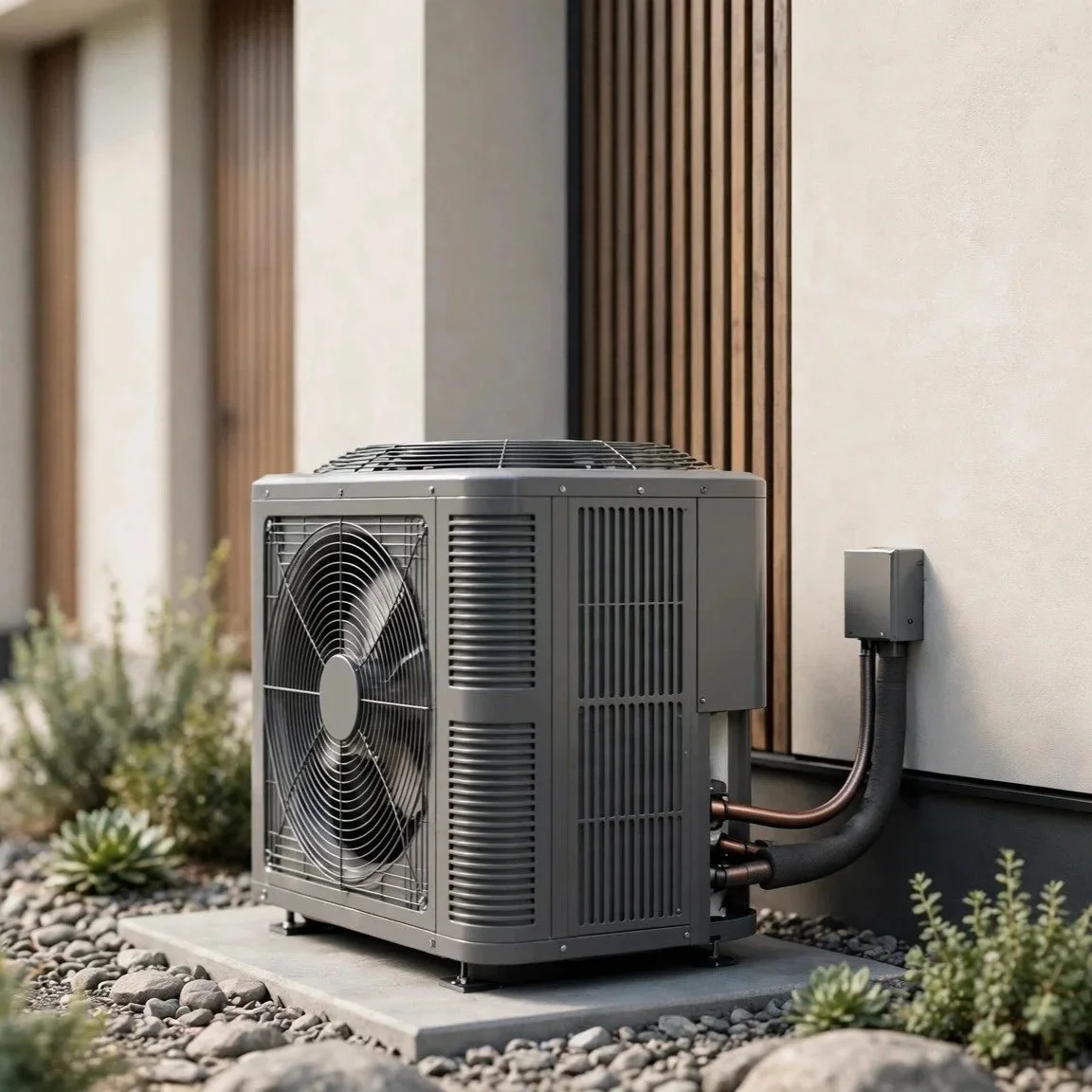
Almost everyone shopping for a new air conditioner asks the same first question: What size do I need? It is the right question, but the word "size" causes most of the confusion. A bigger physical box does not mean more comfort, and a common shortcut, one ton for every so many square feet, sends plenty of homes toward the wrong unit. Before you can pick a number, it helps to understand what that number actually describes and how a system is supposed to behave once it is installed.
Quick Answer: Air conditioner "size" means cooling capacity, measured in tons, where one ton equals 12,000 BTU per hour of heat removal. The correct capacity for your home comes from a Manual J load calculation, not a rule of thumb per square foot. Bigger is not better: an oversized unit short-cycles and leaves the air humid, while an undersized one runs nonstop and still cannot keep up on the hottest afternoons.
What "Size" Actually Means
When an installer talks about the size of an air conditioner, they are not talking about the dimensions of the cabinet outside your house. They mean cooling capacity: how much heat the system can remove from your indoor air in a given hour. That capacity is measured in tons, and one ton equals 12,000 BTU per hour. A three-ton system, then, removes 36,000 BTU per hour, and a four-ton system removes 48,000.
Heat is the thing an air conditioner moves. On a hot afternoon, heat constantly leaks into your house through the walls, roof, windows, and every gap around doors and outlets. It also comes from inside: people, cooking, lights, and appliances all add heat. The system's job is to remove that heat at least as quickly as it arrives. Capacity is simply the measure of how fast it can do that.
This is why the question "what size" is really about balance. You want a unit whose capacity matches the rate your particular house gains heat on a hot day, not much more and not much less. Getting that match wrong in either direction causes real, everyday comfort problems.
Why Bigger Is Not Better
It is tempting to assume that a larger air conditioner is a safer bet, much like a bigger engine that seems like it can never be a problem. Cooling does not work that way. An oversized unit creates its own set of complaints, and they are some of the most common ones people live with without knowing the cause.
An oversized system behaves like a driver who floors the gas pedal to cover one block, then slams the brakes, over and over, never settling into a steady cruise. An air conditioner that is too large for the space blasts cold air, drops the thermostat to its setpoint in just a few minutes, and shuts off. Then the house warms slightly, and it kicks on again. This rapid on-off pattern is called short-cycling, and it works against you in three ways.
First, humidity. Removing moisture from the air is a slow part of the cooling process. Warm, humid air has to pass over the cold indoor coil long enough for water to condense out of it and drain away. A unit that satisfies the thermostat in a few minutes never runs long enough to wring that moisture out, so the house ends up cold and clammy rather than cool and comfortable. Second, uneven temperatures. Short bursts of cooling do not give the air time to circulate through the whole house, so rooms far from the equipment stay warm while rooms nearby get chilled. Hot and cold spots are a classic sign of a unit that is too big. Third, wear. Every start puts the most strain on a compressor, and a short-cycling system starts far more often than it should, aging the most expensive part faster.
An undersized unit has the opposite problem, and it is easier to picture. On mild days, it may be fine, but on the hottest afternoons, it simply cannot remove heat as fast as the house gains it. It runs and runs without ever reaching the temperature you set, and you sweat while the outdoor unit hums along at full tilt. Neither extreme is what you want.
How the Right Size Gets Calculated
If square footage alone will not tell you the answer, what does? The industry standard method is a load calculation known as Manual J. Rather than guessing, it accounts for all the ways heat enters and leaves a specific house and calculates the actual cooling load, in BTU per hour, that the home experiences on a hot design day. That number points to the right tonnage.
A proper load calculation considers far more than just floor area. It accounts for ceiling height, since a room with tall ceilings holds more air to condition. It weighs insulation levels in the walls and attic, because a well-insulated house gains heat much more slowly than a poorly insulated one of the same size. It measures window area, the direction those windows face, and whether they are single- or double-pane, because glass on a sun-facing wall lets in heat that glass on a shaded wall does not. It considers air sealing and infiltration, meaning how much outside air leaks in through gaps. It factors in sun exposure, the local climate, and design temperature for your area, and how many people typically occupy the home.
This is why floor area alone is a weak predictor. Take a tightly sealed, well-insulated home with modest, shaded windows and set it against an older, leaky house of the exact same footprint whose large west-facing glass bakes all afternoon: the first can need a full ton less capacity than the second. The square footage reads identically, while the heat load does not.
None of this makes the rough rule of thumb useless. The old figure of roughly one ton per 400 to 600 square feet is worth knowing as a sanity check. If a calculation for a 2,000-square-foot home comes back suggesting nine tons or one and a half, something is off and worth a second look. But a sanity check is all it is. It cannot see your insulation, your windows, or your afternoon sun, so it cannot replace the calculation that does.
Capacity Is Not Efficiency
One more distinction saves a lot of confusion on the showroom floor. Capacity and efficiency are two separate properties of an air conditioner, and a high number in one has nothing to do with the other.
Capacity is tonnage: how much cooling the unit delivers. Efficiency is measured by a rating called SEER2, which describes how much cooling you get for the energy the system consumes over a season. A higher SEER2 unit uses less electricity to deliver the same cooling, which can lower running costs. But it is still whatever tonnage it is. A very high-efficiency unit that happens to be the wrong size for your house will still short-cycle if it is too big or fall behind if it is too small. Efficiency determines your energy use; size determines your comfort. You choose them separately, and you need both to be right.
Ductwork Has to Match the Equipment
Sizing does not stop at the outdoor unit. The air a system cools has to travel through your ducts to reach the rooms, and those ducts have a limit on how much air they can carry. Airflow is measured in cubic feet per minute, or CFM, and every unit is rated for a specific airflow range.
Put a larger air conditioner on ductwork that was sized for a smaller one, and you starve the equipment of the airflow it needs. When too little air moves across the indoor coil, the coil can get so cold that the moisture on it freezes into ice, which chokes airflow further and can eventually damage the compressor. This is why a thorough installer looks at the duct system, not just the load number, before settling on equipment. Sometimes, the honest answer is that the ducts need attention before a larger or different unit makes sense.
A Right-Sized System in Everyday Use
It helps to picture what "correct" feels like day-to-day. A properly sized air conditioner does not race to the setpoint and quit. It runs longer, gentler cycles at a lower effective output, and those longer runtimes are exactly what let it do its full job: pulling humidity out of the air and circulating conditioned air long enough to even out temperatures from room to room. The house feels consistent rather than swinging between cold blasts and warm lulls.
This evenness matters year-round, not only on the year's hottest day. Heat load is just one factor a good sizing accounts for, and the hottest afternoon is only one condition a system has to serve. Much of the cooling season consists of milder shoulder-season days, and a right-sized system handles them gracefully with steady, moderate cycles rather than the constant stop-start of an oversized one. Getting the size right is what makes the equipment comfortable across the whole range of weather it will face, not just at the extreme.
Frequently Asked Questions
It refers to cooling capacity, not weight. One ton equals 12,000 BTU per hour of heat removal. The term is a leftover from the days when cooling was measured by how much ice it would take to absorb the same amount of heat, and it simply stuck as the unit for capacity. So a three-ton unit moves 36,000 BTU per hour, and each additional ton adds 12,000 BTU per hour.
No, because cooling does two jobs at once. It removes sensible heat, the part you read on a thermostat, and latent heat, the moisture in the air. An oversized unit knocks down sensible heat in minutes and shuts off, but removing latent heat is slow and requires long runtimes, so it never gets to that second job. You end up with a house that is cold and clammy rather than cool and dry, plus a compressor that wears early from starting and stopping far too often, a pattern called short-cycling.
It is the industry load calculation that accounts for heat gain from square footage, insulation, windows, air leakage, sun exposure, and occupancy to determine the actual cooling load of a specific house, rather than a generic estimate. It is also only the first of three steps a careful contractor runs: Manual J sizes the load, Manual S then selects the specific piece of equipment that matches that load, and Manual D sizes the duct system to carry the air. Skipping the last two means a correctly calculated load still ends up on the wrong equipment or ducts.
A per-square-foot rule, roughly one ton for every 400 to 600 square feet, is only a rough sanity check. It also ignores airflow, which a real design has to match: a system moves on the order of 400 CFM of conditioned air per ton, so tonnage and duct capacity are linked in a way a floor-area guess never sees. Two homes of equal size can differ by a full ton once insulation, window area, and sun exposure are counted, so the shortcut can be off by a wide margin and cannot replace a proper calculation.
Yes. The ducts have to move the airflow the equipment is rated for, measured in CFM, and undersized ducts cannot carry the airflow a larger unit needs; starve the unit, and the indoor coil can get cold enough to ice over. The equipment type changes the math, too. A single-stage unit is all-on or all-off at a fixed output, but a variable-speed or inverter compressor can modulate, ramping its capacity up and down, which lets it match a wider range of loads and duct conditions than a single fixed-tonnage unit would. Proper sizing accounts for the ducts and the compressor type, as well as the load, not just the equipment box.
No. SEER2 measures how efficiently a unit uses energy, while tonnage measures how much it cools, so a high-efficiency unit that is the wrong size still short-cycles if it is too big or falls behind on hot days if it is too small. One thing to know when comparing numbers: SEER2 replaced the older SEER rating in 2023 using a tougher test that reflects real-world duct resistance, so a SEER2 figure runs a bit lower than the old SEER value for the same unit, and the two are not directly comparable. Size and efficiency are two separate decisions, and both have to be right.
Book a free in-home load calculation — get the exact tonnage your house needs so your system dehumidifies, runs quietly, and cools evenly. Hi-Tech Heating and Cooling serves Albuquerque, Rio Rancho, Corrales, and the surrounding area. Call (505) 398-4398 for a consultation.
