
Signs Your Ductwork Is Leaking, and Which Side It’s On
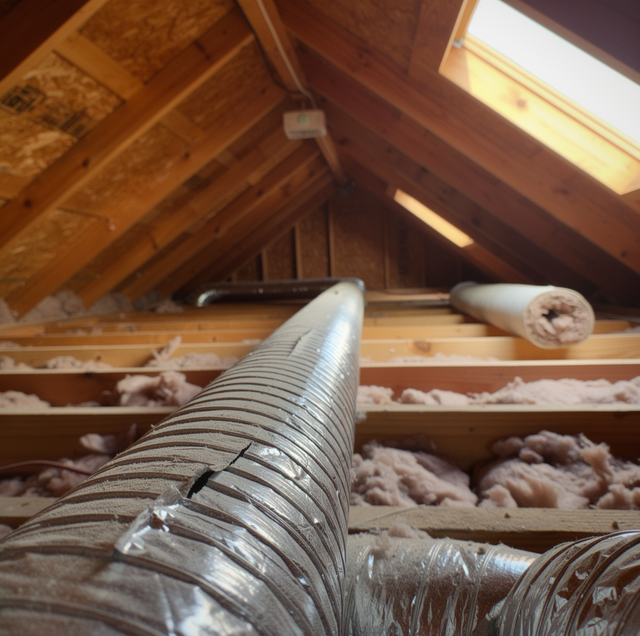
Duct leakage is the one heating and cooling fault where the equipment can be working perfectly, and the house still is not comfortable. The refrigerant charge is right. The temperature rise across the furnace falls inside the nameplate range. The blower draws the amps it should, and the thermostat gets an answer every time it calls. The back bedroom still sits four degrees behind the hallway all afternoon. Nothing measured at the equipment explains that, because the fault is not at the equipment. It sits in the path between the equipment and the room, and that path is under pressure.
Quick Answer: Supply ducts run positive and push conditioned air out of a leak. Return ducts run negative and draw in unconditioned air. Weak air at the far registers points to the supply side; sudden dust and odor point to the return.
Supply Ducts Push Air Out, Return Ducts Pull Air In
A duct system is not a passive set of tunnels. The blower is a pressure machine, and it splits the system in two. Everything downstream of it, meaning the supply plenum and every branch and boot that feeds a register, sits above the pressure of the house. Everything upstream, meaning the return grille, the return trunk, and the cabinet the filter drops into, sits below it. A residential system commonly operates around 0.1 to 0.5 inches of water column of static pressure, roughly 25 to 125 pascals, and that difference is what moves air.
A hole does not know which side it is on. It only knows which way the pressure points. Punch one in a supply duct, and you have a hole in a pressurized container, so conditioned air you already paid to heat or cool leaves through it and goes wherever that duct happens to run. Punch the same hole in a return duct, and it becomes an inlet, because the duct is below house pressure, and the system pulls in whatever surrounds it.
| Supply side | Return side | |
|---|---|---|
| Pressure relative to the house | Positive | Negative |
| What a hole does | Pushes conditioned air out | Pulls unconditioned air in |
| First thing you notice | Weak air at distant registers, long run times | New dust, new odors, humidity that moves on its own |
| Where it hides | Branch runs, boots, joints buried in insulation | Cabinet seams, filter slot, grille framing, wall and joist cavities used as returns |
A Leak Outside the Insulated Envelope Matters Far More
Two identical holes can have very different consequences depending on what the duct is passing through at that point. A supply joint that lets go inside a floor cavity between two conditioned rooms delivers air to the wrong place, which is a comfort problem, but the heat stays inside the thermal boundary of the house. The same joint in an attic or a crawlspace sits outside that boundary, so every cubic foot that escapes is gone and the system runs longer to make up for it.
The numbers behind this are not small. Federal efficiency guidance has long put duct losses in a typical house at roughly 20 to 30 percent of the air the blower moves, with the worst cases in systems routed through unconditioned space. That is the fraction of the equipment's output that never reaches a room.
The return side of the same geometry is worse in a different way. Attic air under a sunlit roof climbs well past outdoor temperature and can sit above 130 degrees on a summer afternoon, and a vented crawlspace holds close to ground temperature and ground moisture. A return leak in either place is not just losing conditioned air. It is feeding the equipment a different air supply than the one you live in.
Weak Air at the Farthest Registers Points to the Supply Side
Airflow to a room is what remains after the resistance of the entire path is subtracted from the pressure the blower produces. The branch that runs farthest, turns most, and ends in the smallest boot already has the least margin. When a leak opens upstream of that branch, it relieves pressure and the pressure behind every downstream run drops, so the run with the least margin starves first.
The tell is that the weakness is selective. Put your hand at each register with the blower on high. A leak weakens the runs downstream of it, while the registers nearest the plenum feel normal or even strong; a restricted filter or a collapsed flex run does the opposite and weakens everything at once. Selective weakness with normal equipment readings is a supply-duct signature, and the runs that go quiet first are usually the ones with the longest trip through an attic or crawlspace.
Long Run Times With One Room Always Behind
A supply leak sends conditioned air to a place nobody occupies, so the thermostat never sees it. The hallway sensor is satisfied, the cycle ends, and the far bedroom is still short. Then the load bleeds back into that room, and the cycle starts again. Longer run times, shorter off periods, and one room that never catches up in either season are the pattern, and they point to capacity being delivered somewhere other than the rooms.
There is a differential worth naming before you go looking for holes. Closed interior doors can produce an almost identical complaint with no leak anywhere, because a closed room with a supply register and no return path pressurizes against its own airflow. That is a diagnosis of its own, and the way to separate it is simple: if the room behaves when its door is open and misbehaves when it is shut, pressure balance is a stronger suspect than duct leakage.
Dust That Outruns the Filter Points to the Return Side
A filter only cleans the air that passes through it. Any opening on the return side downstream of the filter position admits air that never sees the filter media, and that air goes straight into the blower, over the coil, and out to your registers. A return leak is a bypass around the entire filtration system.
The signature is a mismatch. Surfaces gray over within days of being wiped, registers pick up a dark fringe at their edges, and yet the filter looks less loaded than a house this dusty should produce. Where the leak sits decides what arrives: fiberglass and cellulose fibers from an attic, gypsum and framing dust from a wall cavity pressed into service as a return, fine soil particles from a crawlspace. Which filter belongs in the slot is a separate question, and no filter rating changes what a bypass admits.
Odors and Humidity That Match the Space Around the Duct
Air carries the character of wherever it was drawn from. A return leak in a garage pulls vehicle exhaust, fuel vapor, and whatever is stored on the shelves into the return stream. A crawlspace leak brings an earthy or musty note that shows up strongest in the first minute of a cycle, when the duct's stagnant contents arrive before anything else. If a smell appears when the system starts and fades when it stops, the return is sampling a space you do not want sampled.
Humidity behaves oddly for the same reason. A return that pulls damp crawlspace air raises indoor moisture during runtime, while one that pulls very dry attic air lowers it; in both cases, the reading moves with the blower rather than tracking the weather. A return leak to the outside also pushes the whole house slightly negative, which drags outdoor air in through every gap in the shell, so the house feels less sealed than it is.
Return Leaks Near a Combustion Appliance Belong to a Professional
If the return leak sits inside a closet or utility room that houses an atmospherically vented furnace or water heater, the stakes change. Those appliances vent by buoyancy alone, on a pressure difference of only a few pascals, and a return leak that pulls that room negative can slow or reverse the draft. That is a carbon monoxide question, not a comfort question. Do not test it, do not seal around it, and do not run the system while you investigate it.
A natural-draft appliance holds its flue draft on a pressure difference of only a few pascals, and depressurization much beyond five is enough to spill combustion gas into the room. Keep working carbon monoxide alarms on every level while this is unresolved.
Supply Temperature the Equipment Cannot Explain
The most reliable way to separate the two sides costs one thermometer and four readings: the return grille in the room, the return at the air handler cabinet, the supply plenum, and the farthest register.
If the return grille reads 75 degrees in cooling but the air arriving at the cabinet reads 88, the system is mixing your house air with something else on the way, and the return has a leak. That mixing is arithmetic you can do. If a quarter of the return volume enters through a hole in a 130-degree attic while the house holds 75, the air reaching the coil arrives near 89 degrees. The equipment has to pull that borrowed heat back out before it does anything for you, and the coldest supply air it can produce rises with the temperature it was handed.
If instead the plenum reads correctly and the far register reads several degrees warmer in cooling, the equipment did its job, and the run lost the result on the way. That is the supply side, and the distance between the two readings tells you roughly how much of a run is exposed. A supply temperature that is worse than the nameplate says the equipment should be able to deliver, on a system with a correct charge and a clean coil, is almost always the return being fed air from somewhere it should not be.
A Duct Pressurization Test Is What Settles It
Everything above narrows the search without measuring the leak, and honesty matters here: a visual inspection finds the obvious failures, a boot hanging off a ceiling collar or a trunk seam standing open, and misses most of the rest. Leaks hide inside insulation wrap, behind wall finishes, at cabinet seams and at the filter slot, and small ones in many places add up to more than the single big one you can see.
The measurement that ends the argument is a duct pressurization test. A technician masks the registers and grilles, connects a calibrated fan to the duct system, brings the ducts to a reference pressure of 25 pascals (about 0.1 inches of water column) relative to the house, and reads the airflow the fan must supply to hold that pressure steady. That airflow is the leakage, in cubic feet per minute, and it is a number you can compare before and after a repair rather than an opinion about how the ducts look.
Sealing is the other half, and it is not homeowner work. Attics and crawlspaces carry real hazards: heat that builds through the afternoon, ceiling framing that will not hold your weight between joists, wiring, and insulation that hides both.
Cloth-backed duct tape is not duct sealant. In laboratory aging tests of duct sealing products, it was the one material that reliably let go. Brushed mastic, or foil tape carrying a safety listing, is what holds.
Frequently Asked Questions
Look for dust tracking rather than for holes. A supply leak deposits a dark smudge on the insulation or framing around the opening, since escaping air drops its dust load at the edge, and that stain is often visible in a basement or garage long before the gap is. A return leak sometimes announces itself as a faint whistle at a cabinet seam in the first seconds after the blower starts.
It does, and the reason is delivery temperature. A heat pump commonly supplies air in the 90 to 105-degree range, while a gas furnace supplies 120 to 140 degrees, so the heat pump starts with a much smaller gap between the air in the duct and the space around it. The same length of leaky run in an unconditioned space erases a larger share of the heat a heat pump was carrying.
Yes. A disconnected or badly leaking duct becomes a passive air path, and warm air rising through the house pulls replacement air along any open route, including through the duct. A room served by a failed connection can feel cool and moving at night with the equipment idle, which is a useful clue because no blower is involved.
Both approaches exist. Accessible joints are sealed from the outside with mastic reinforced by mesh at wider gaps. Where ducts are buried or unreachable, an aerosol method seals from within: the registers are masked, the system is pressurized, and an atomized sealant is carried to the leaks, where the particles collect at the edges and bridge openings up to roughly five-eighths of an inch.
Leakage is judged relative to the size of the house, so results are normalized as airflow per 100 square feet of conditioned floor area rather than as a raw number. A second reading, taken with the house held at the same pressure as the ducts, separates total leakage from leakage to the outdoors, and that second figure determines how much of the loss is actually leaving the building.
Neither material leaks on its own; connections do. Flex fails at the collar, where the inner liner is banded to a takeoff or boot and the band was left loose or the liner was not pulled fully over the fitting. Sheet metal fails at longitudinal seams and at boot joints. Flex has a second problem that gets confused with leakage: a sagging or compressed run restricts airflow without losing a cubic foot of air.
Book a duct performance inspection — find out which side of your system is losing air, and how much. Hi-Tech Heating and Cooling serves Albuquerque, Rio Rancho, and Corrales. Call (505) 398-4398.
